Tooth Brushing
Most of the children with autism face issues with brushing. Tooth brushing is managed 'some how'. Some times, the strategies that are used to ensure children brush their teeth can result in trauma for the child, engendering negative attitudes towards brushing, and resulting in a lot of distress.
A variety of issues that are often seen with children on the spectrum are - Unable to open mouth to brush, Unable to allow a brush inside the mouth, eats away the toothpaste, Unable to gargle, Unable to spit, Putting too much or too little pressure while brushing etc.
What can a parent do
Identify the issue - The specific issue that a child has to be identified correctly so an intervention can be planned. The person facilitating brushing needs to be clear with what the autistic person finds challenging and plan support accordingly. Not everyone needs everything. If it is a sensory issue, a separate intervention needs to be planned based on the issue - for example, getting specific kinds of toothbrushes like vibration brush, using specific flavoured toothpastes, planning specific massages to prepare the child for brushing.
Acknowledge the difficulty - It is important to acknowledge the issues that the autistic person has with brushing Avoid feedback such as ‘Drama, ‘Too much’, 'everyone does brushing, what’s your problem’ etc. Rather, you can say, ‘I understand you are quite upset about brushing. Let us follow schedule and I am here to help you go through it'.
Preparation - Preparation plays a huge role in developing a favourable attitude to brushing. Having a visual schedule which shows when it is time to brush is one of the key steps. Social stories and general story books about brushing can also help preparation.
Tooth brushing social story
The social story focuses on tooth brushing practices. Read this story repeatedly to reinforce learning. Remember social stories are most effective when used just before situations they address. Also, ensure the social story in in accordance with the real life situation - if not, you can change the relevant portions and use it.
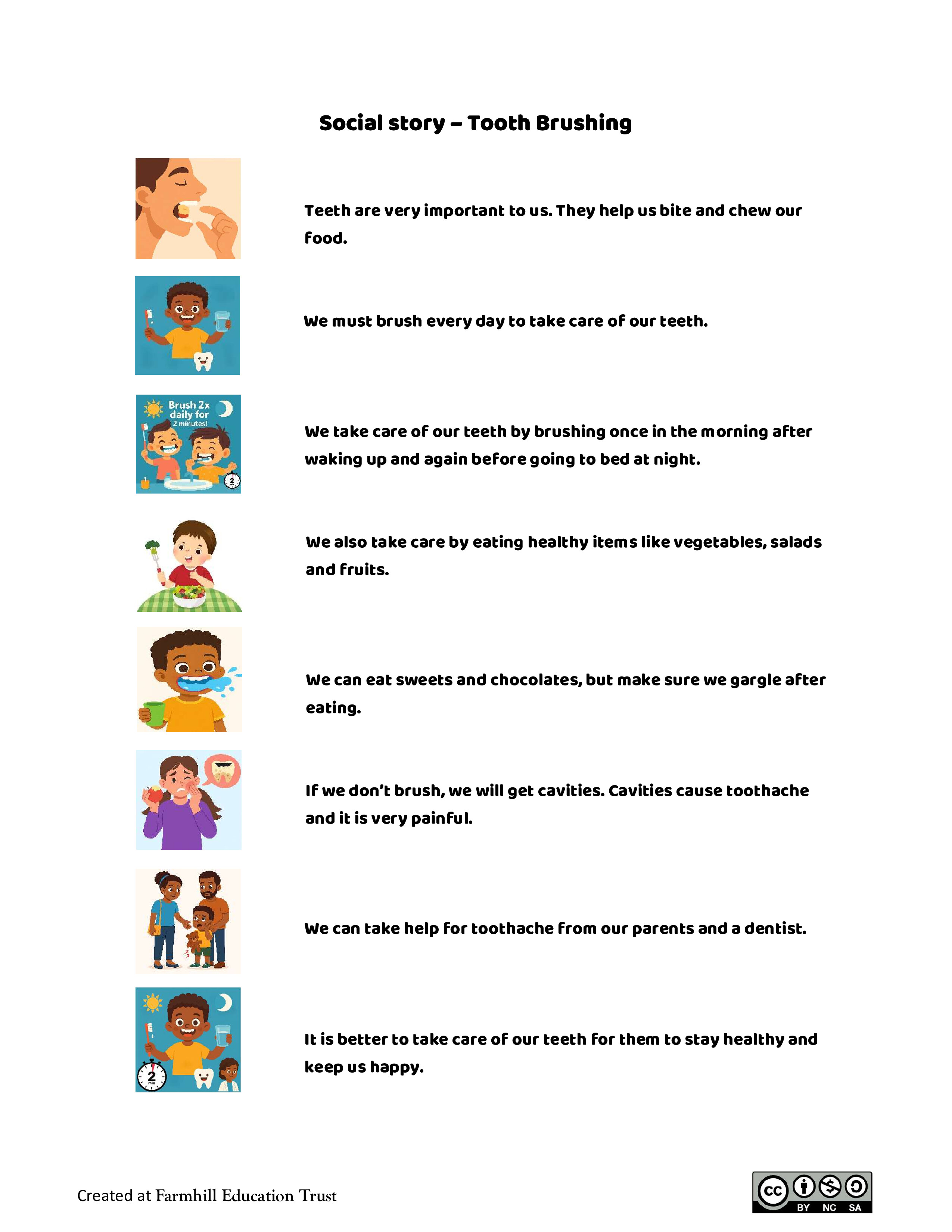
Download Tooth Brushing Social Story
Tooth brushing graphic story book
Tooth brushing graphic story book focuses on the importance of brushing teeth, and provides a visual structure for tooth brushing. The activities included reinforce the same.
Download Tooth Brushing Graphic Book
Supporting tooth brushing
Visual prompt for toothbrushing
This is a video demonstrating the use of visual prompts to teach toothbrushing. This child has all the skills needed for brushing. He needs help with following a sequence. A visual prompt is a picture that the child/person refers to during the process. There is absolutely no need to give any kind of instruction. Notice that the facilitator does not say anything in the entire video. The facilitator just points to the picture and the child follows. The facilitator also gives counts where repetitions are needed. This ensures that the brushing is done for at least 2 minutes.
The child could follow the sequence when the facilitator pointed to the picture. The facilitator did not say anything through out the video. This is crucial for the prompt to stay with the visual and not with the facilitator. The child kept referring to the visual prompt with support in the video. Eventually, the child learns to follow the visual by himself and follow the sequence. The child learns to brush by himself.
Modelling and Physical Prompts
A visual prompt works when a person has the skills to perform the different steps as shown in the prompt. What do we do when the person is not independently able to perform some steps?
This video shows such a situation where we use a combination of visual, modelling and physical prompts. As a prerequisite, we need to have some idea of what the person can do independently and where they may need more help than just the visual.
Visual prompt: We point to the visual prompt for the steps the person is able to perform independently.
Modelling prompt: We use modelling for steps where the person can perform the action imitating the facilitator. Notice that the facilitator points to the visual, says 'Do this' and then performs the action. The person imitates. Notice that the only instruction is ‘Do this’ for modeling. Also, facilitator says 'Do this' to get the person's attention. If the person is already looking at the facilitator, even this instruction is unnecessary. Modelling can be done without instruction.
Physical prompt: When the person finds it difficult to perform a step, the facilitator holds the hand and supports them to do the task. Notice that the facilitator points to the visual, holds the person's hand and then he performs the action. The physical prompt does not need any instruction.
The facilitator also gives counts where repetitions are needed. This ensures that the brushing is done for at least 2 minutes.
As the person becomes more fluent and independent in each of the stps, physical prompts can become modelling prompts, modelling can become visual prompt and eventually, the support can also be removed completely as the person starts to brush by themselves.