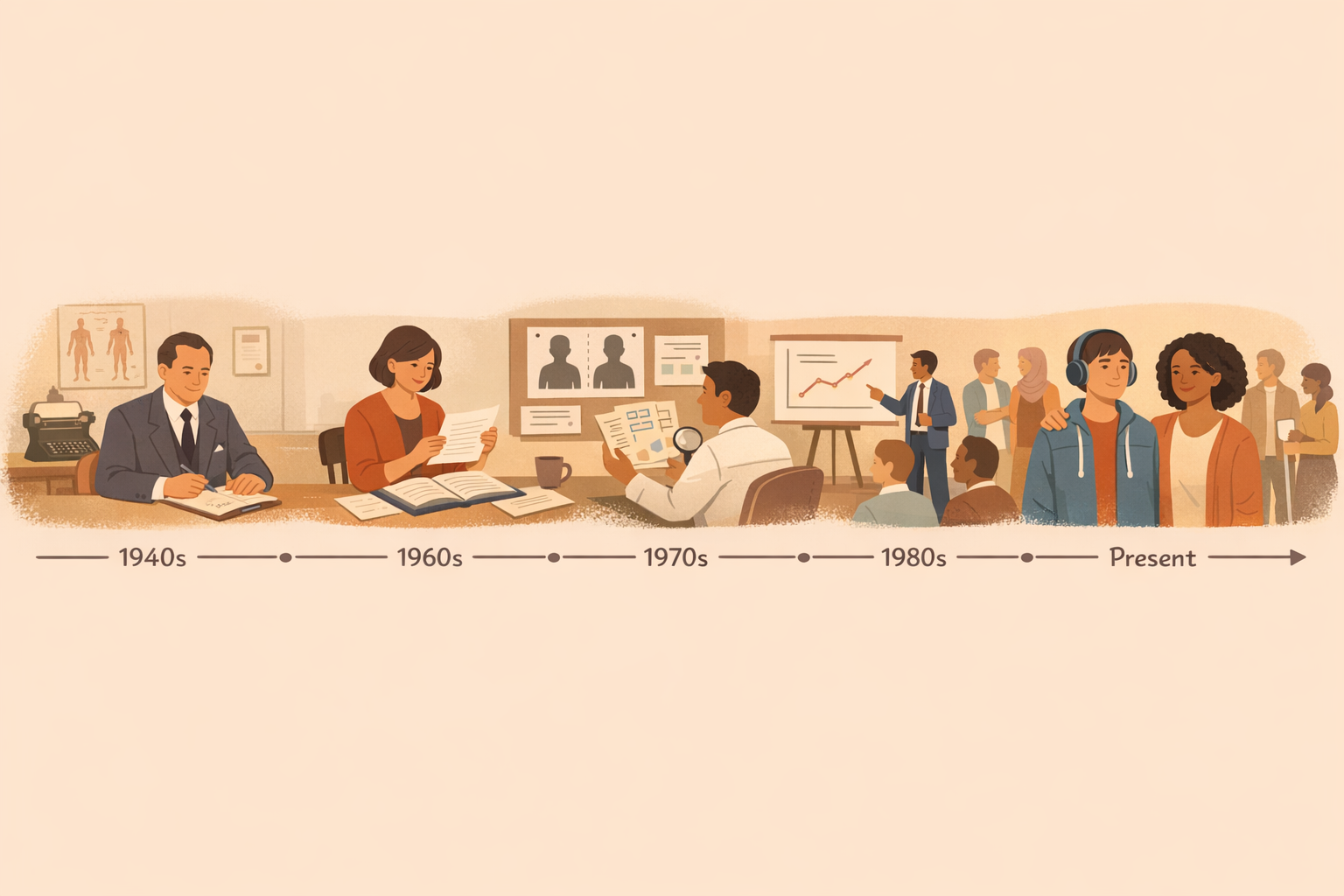
The importance of a histroy of autism
Why is the history of autism important? Why is the history of any scientific idea important, for that matter?
The history of a scientific idea is important because science develops in the context of the challenges faced in a particular time and place. People who are doing science do not work in a vacuum, so what they notice and the way they interpret what they see, both depend on the context in which they are operating. However, when these interpretations become part of the science, they are sometimes seen to be somehow ‘objective’ by later day practitioners and students. This leads to a loss of context and inhibits the ability to critically examine older ideas, thereby giving them a longer life than they deserve.
::: {.callout-tip}
Video Available
This TED Talk by Steve Silberman covers some key points in the history of autism. :::
Nowhere is this more visible than in the case of autism.
The acknowledged pioneer of autism research in the US was also the proponent of the claim that ‘refrigerator mothers’ caused autism. He focused on one specific end of the autism spectrum, ended up conveying the idea that it is a severely disabling, rare condition, and that led to a certain stigma around autism.
Another pioneer of autism, while he had a better understanding of the variety of autistic traits, had to focus on the ‘higher functioning’ end of the spectrum, as he worked in the Nazi regime that did not have a place for the ‘feeble minded’.
While both are Germanic, they wrote in two different languages making it difficult to reconcile these two ideas. Both failed to acknowledge the work of brilliant clinicians, who, incidentally, worked with one first and then with the other.
Both might also have known about but ignored the seminal contributions of a Soviet Jewish woman psychologist, possibly due to antisemitism, sexist attitudes, and anti-Soviet sentiments. These contributions, if accounted for properly, would have made autism what it is today, but much earlier and with much less misery all around.
Coming a little later, a parent of an autistic child, who worked tirelessly to disprove ‘refrigerator mother’ theory was also a supporter of controversial programs and alternative treatments like chelation, use of aversive and believed in the vaccine-autism link which was later discredited.
Then it took a British woman psychiatrist, also the mother of a severely autistic child, to bring these accounts together and help us see autism for the spectrum it is. It took the accounts of a few autistic adults like Temple Grandin and Judy Singer, movies like Rainman, the recent tireless work of journalists like Steve Silberman, as well as countless others, to put the idea of neurodiversity as the basis of looking at and understanding autism, as we do today.
So, yes, the history of autism is interesting and informative. Let's dive in for more detail!