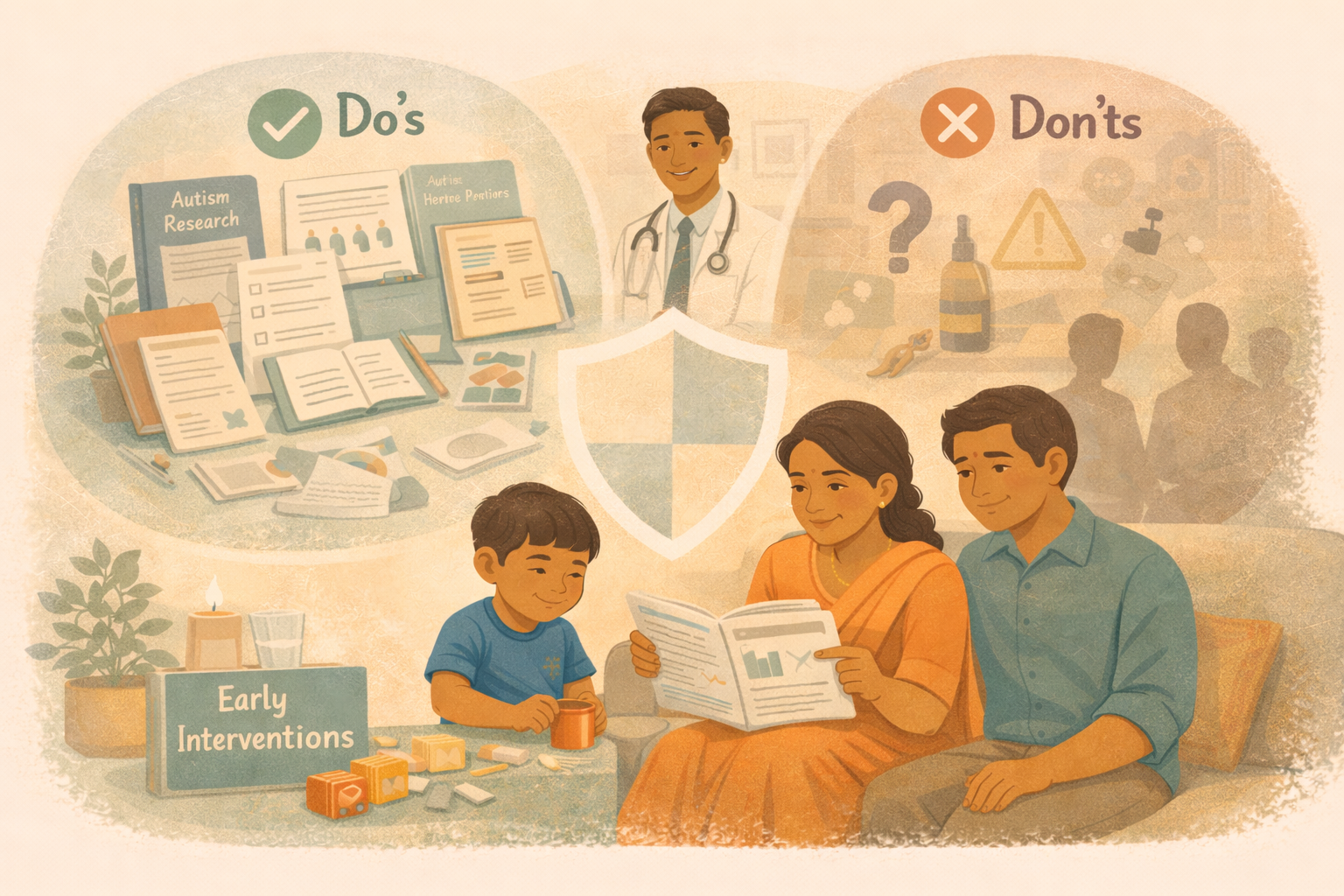
Cures and Treatments - be cautious
In this section we examine some of the alternative treatments to autism.
::: {.callout-caution} Please note that the alternative treatments for autism discussed here are considered ineffective and some can be outright dangerous. These are included to provide a cautionary note and are NOT recommended. :::
Why do people seek alternative treatments?
There are many alternative treatments or protocols advised for conditions like diabetes, skin allergies or even cancer. Similarly, there have been many alternative treatments that have been and continue to be practiced for autism, despite no evidence of effectiveness. In some cases, people believe in and are willing to try alternative approaches, even when there is evidence of harm.
What prompts people to try these approaches, against all reason?
Newly discovered conditions
When a condition is newly discovered or becomes widespread, and an effective treatment is yet to be determined, it is typical for people to explore a range of potential causes, treatments and “cures”. An approach that might have been effective for a different condition that appears to be related may be tried. For example, in the case of COVID, when the infection hit, there was no cure. Healthcare workers primarily focused on providing symptomatic treatment and tried approaches that worked for other infections and respiratory conditions like flu. A variety of treatments ranging from allopathy, ayurveda to homeopathy were tried before a vaccine was developed and a protocol that works was devised.
Seeking better results with less effort
Even when some understanding and evidence-based interventions are available, there might be a desire to seek alternative solutions in the hope of achieving better or anticipated results, and with lesser effort. For example, it is understood that diabetes cannot be cured but can be managed with lifestyle changes. Many people find these lifestyle changes difficult to make and maintain. They seek alternative approaches instead.
Inability to critically evaluate
It is also possible that people may not have the mental capacity to critically evaluate the feasibility of promised cures versus the potential harm as they deal with the stress placed by the condition they are dealing with. Sometimes they also believe that they have tried everything there is to try and there is no harm in trying one more thing. You see this approach in people dealing with cancer and such life threatening conditions.
The case of autism
Many of these factors seem to be working in the case of people who are willing to try alternative treatments for autism. Autism has been a poorly understood condition whose cause is not clearly known. It impacts children and it is no secret that many of us do not understand parenting, education and child development well enough. When a child is diagnosed with autism, parents do not immediately understand all the implications and its lifelong impact. Many see it as improper behavior on the child’s part or a set of symptoms that are preventing the child from going to school and seek to address them quickly, in time for the child to join a school. They also hear from healthcare professionals that there is no medical cure for autism. The evidence based interventions are behavioral, requiring significant time, energy and resource commitment from everyone involved. Most people are stressed out with the effort of bringing up the child and an autism diagnosis just makes things worse.
It is in such an environment that alternative approaches, promising cures or at least significant improvements quickly, with little or no effort, become popular. Some of these are approaches that work for another condition, e.g. chelation, which is a treatment for heavy metal toxicity. Chelation was tried for autism initially because symptoms of autism resembled mercury poisoning and later because people believed autism was caused by mercury from vaccines. Similarly, hyperbaric oxygen therapy works for traumatic brain injury and was tried for autism because people believed increasing oxygen supply to the brain can help autism. There is homeopathy, which has been tried for everything that is not well understood in current medical science. In the Indian context, there is ayurveda, siddha and other alternative systems offering everything from remedies to cures for autism. Many others like restrictive diets are approaches that claim to cure a wide variety of conditions.
Caution: Alternative approaches
Currently, we understand Autism as a brain wired differently. Symptoms of autism may pose some social challenges for individuals in the spectrum, for which one can seek symptomatic treatment to enable a functional and meaningful life within the society. The cause of autism is unclear and so is the cure for autism. Scientifically, no evidence supports the existence of a "cure" for autism. Evidence-based interventions aim to manage specific symptoms, yet other interventions driven by speculative theories of "curing" autism not only lack efficacy but can also result in severe side effects. Consequently, interventions that demand careful attention and caution include:
- Chelation
- Miracle Mineral Solution (MMS)
- Stem cell therapy
- Hyperbaric oxygen therapy (HBOT)
- Restrictive diets
- Homeopathy
- Ayurveda
When to be critical
Some treatments might appear appealing due to their success in addressing a different condition with similar symptoms, success stories from certain individuals, or alignment with personal beliefs or expectations of a cure. However, it is important to exercise serious caution when the intervention is promoted in the following ways:
- The treatment lacks substantial scientific evidence or is based on unverified claims.
- There is pressure or persuasion to adopt the intervention without clear and transparent information about its potential risks.
- The treatment is presented as a "miracle cure" or a one-size-fits-all solution for a complex condition like autism.
- Claims of success are primarily anecdotal and not supported by reliable research or clinical evidence.
- The intervention involves risks or potentially harmful side effects that are not adequately addressed or disclosed.
A guide to decision making
Distinguishing between legitimate therapies and questionable ones can be challenging, particularly when conventional approaches seem ineffective for parents of autistic children. While alternative treatments may, in some cases, offer assistance, it's crucial to recognize that no single method is universally effective for treating autism. If you are contemplating a non-traditional option, the following questions can guide your decision-making process:
- Who is recommending this option and what do they have to gain if you accept?
- What do reliable sources such as the CDC (Centers for Disease Control and Prevention) or NIMH (National Institute of Mental Health) or The Central Drugs Standard Control Organisation (CDSCO) have to say about this particular method?
- What do established organizations led by people living with autism, such as the Autistic Self Advocacy Network (ASAN), Action for Autism (AFA) and the Autistic Women and Nonbinary Network (AWN) have to say about this therapy?
- Is this method aimed at "curing" autism?
- What are the potential risks related to using this treatment?
- What methods are in place to ensure the person's safety?
- How will you measure changes or improvements?