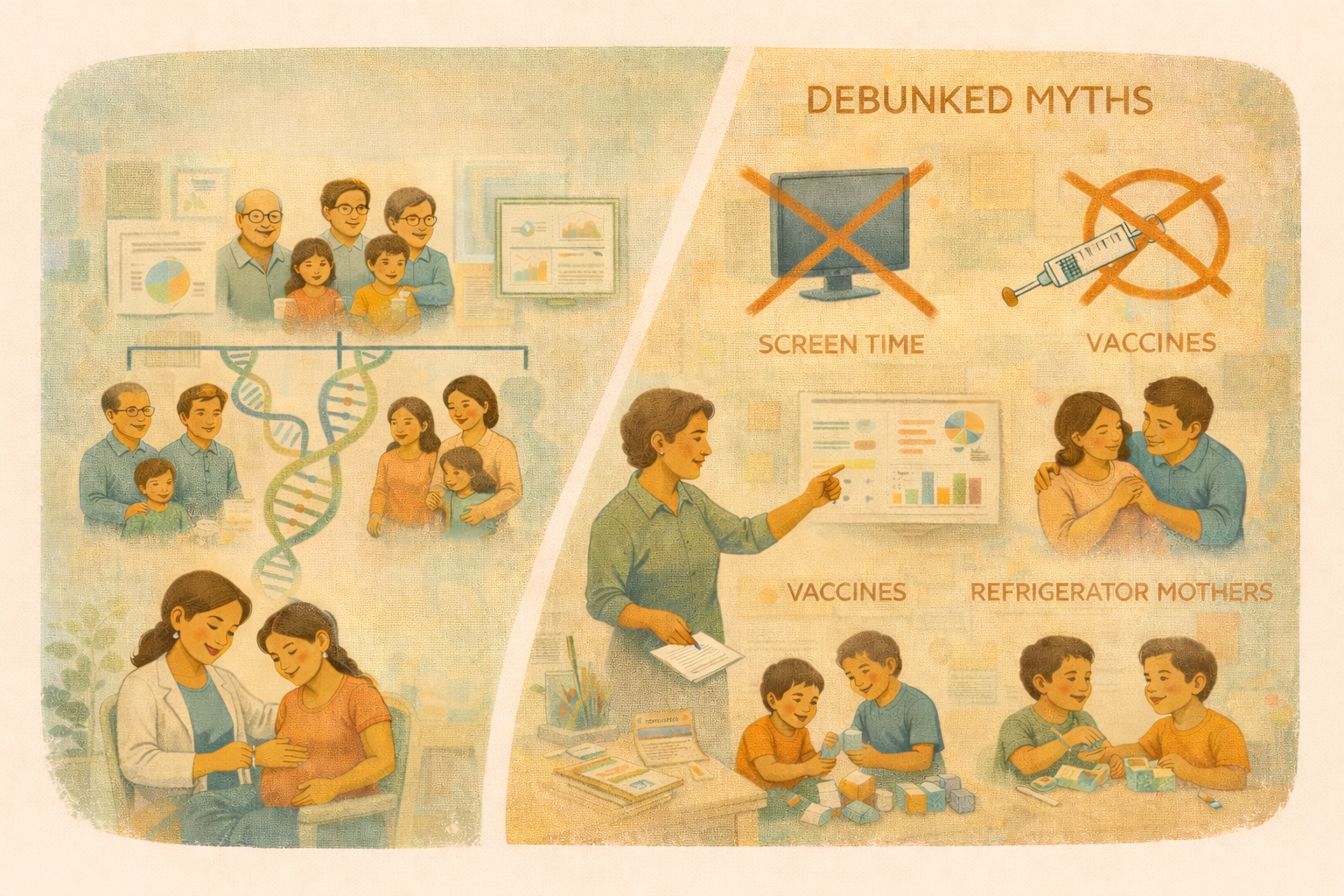
What causes autism?
Most families first respond emotionally when they are told that their child is on the autism spectrum. Some go through denial; others are sad or furious. Soon, emotions give way to questions and one of these questions is - “What caused my child’s autism?” Parents often ask themselves what they could have done differently. Another thought is that if we know what causes autism, maybe we can “cure” it. Some parents also ask this question as they plan to have another child and wonder about the risk of the other child also having autism.
The truth is, we do not really know the specific causes of autism. Therefore, it follows that there is no way any parent could have done anything different so their child would not have had autism. Also, since autism is a natural variation in neurodevelopment, currently there is no way to “cure” it. However, the information we have from current studies indicates that if one child in a family is autistic, there is a higher chance of having another autisitc child.
::: {.callout-note appearance="minimal"} What we know about causes of autism is that there are a variety of factors - “a spectrum of causes” - behind the occurrence of autism, including genetic and environmental factors. :::
Genetic Factors
Genetics plays a large role in the incidence of autism, as evidenced by a 2019 study of more than 2 million people across five countries, which estimated ASD’s heritability to be approximately 80%.
The role of genetics is also indicated by the concordance rate (both of two siblings having autism). In siblings, who share 50% of their genes, the occurrence of autism in both the siblings (the concordance rate) is 20%. Similarly, in fraternal twins, who share 50% of genes and grow in the same womb, the concordance rate is 31%. However, genetics are not the only causal factor - this is evidenced by the concordance rate of 77% even in identical twins, who share 100% of their genes, and grow in the same womb.
Here is a TED talk by Wendy Chung where she talks about genetic factors in autism.
Genetics play a large role does not mean autism runs in the family. Certain individuals have it brand new because of mutations in the sperm or egg at the time of conception which are not passed down. Also, while we know genetics play a large role, the current studies do not provide information on what genes are involved, or even if it is a combination of genes. Furthermore, A study by Simons Foundation found that the genetic changes/ alterations were different for different individuals even among a population of 2600 that had brand new autism - this means there is not 1 gene, but about 300-400 genes (that are not random, but fit together in a pathway/ network) causing autism - possibly why there is such a wide spectrum of autism.
Environmental Factors
A variety of environmental factors have been examined for their contribution to autism. While there are studies that have found correlation between some environmental factors and the incidence of autism, it is important to note that the research is in early stages. The evidence for some of these factors is strong and for some, it is confusing or weak. While we know some of these factors play a role, we do not know how exactly how that role works. In addition, some factors like air pollution are so generic and so widespread that there is little anyone can do about them. So, while we know in general that there are a variety of environmental factors, we do not have a single, actionable, point that can make a significant difference.
Some of the environmental factors that have a strong to moderate current evidence are:
- the use of certain medications during pregnancy - Valproic acid (given for epilepsy), Selective Serotonin Reuptake Inhibitors (Used to treat depression)
- extremely preterm birth and low birth weight
- Older parental age at the time of conception
- Bacterial and viral infections in the mother while pregnant
- Maternal autoimmunity
As of now, we do not exactly know what causes autism. There is much research being conducted on both genetic and environmental causes and the early results are promising. However, if a family has a child on the spectrum now, it might be more important to ask what can help the child rather than what causes autism, since the second question is unlikely to be answered in the near future in a definite way that can change the current ways of supporting autism.